Does Rain Wash Away A Pest Control Treatment?
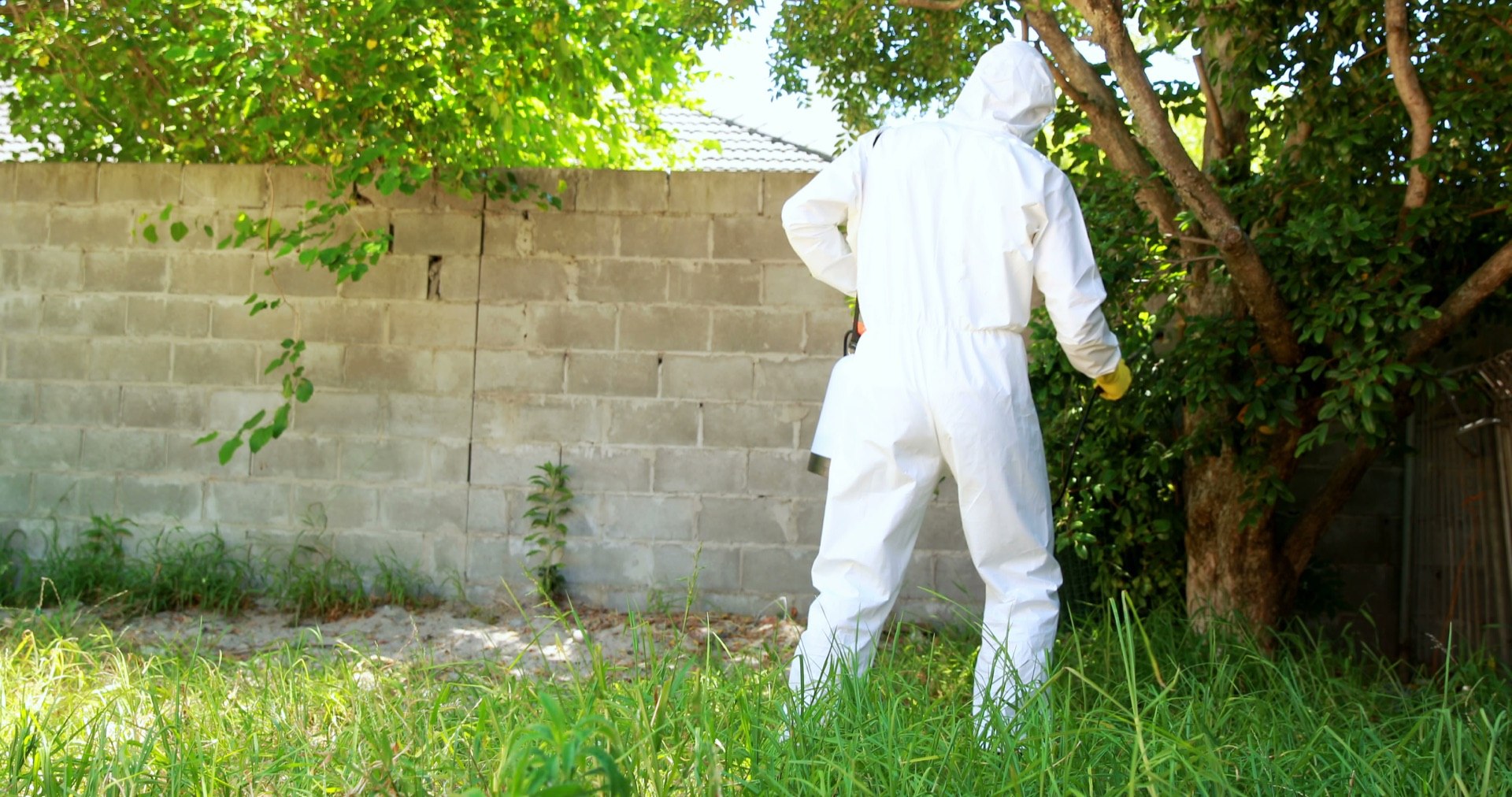
Sometimes, and the timing decides it. Rain that arrives before an exterior application has dried can move product off the surface it was aimed at, which is why labels set a dry time and a rain window. Once it has dried and bound, weather wears it down over weeks instead of washing it off in an afternoon. Interior work, sealed openings and enclosed stations are untouched either way.
The question comes in after every wet stretch, and it comes in hardest in the fall, when a technician works a foundation line in the morning and Northeast Ohio gets two days of rain behind it. What follows is what actually happens to an exterior application in weather, taken from the labels that govern the work rather than from the way a wet sidewalk looks.
Does Rain Wash It Off, Or Wear It Down?
Two different events get the same name. Before an application dries, the liquid sitting on block, mortar or a concrete apron is still mobile, and water crossing that surface carries some of it along. That is runoff, and it is the thing EPA label language is written to prevent. After the application has dried and bound to the surface, the loss is slower and steadier: sunlight degrades it, water erodes it, and the surface itself matters, because porous block holds a residue differently from a painted sill or bare soil.
Either way, an exterior band has a working life measured in weeks rather than seasons. Ohio State University Extension, in its carpenter ant fact sheet (HYG-2063), puts a perimeter treatment at four to six weeks through the summer, or a re-application within a week after a heavy rain. What that means for a whole year of scheduling is the subject of our guide to how often an Ohio house should be treated.
Runoff is not only a first-hour risk, either. One pyrethroid label in EPA's product label system (EPA Reg. 499-522) states that the product has a potential for runoff for several weeks after application, and that poorly draining soils and soils with shallow water tables are more likely to produce it.
The Rain Window Is Printed On The Label
For a licensed applicator this is not a judgement call about the sky. It is a label instruction, and the label is the law. EPA tightened that language for outdoor non-agricultural products: its January 10, 2013 letter to pyrethroid registrants approved revised environmental hazard statements and general directions for use, written to reduce runoff and drift from residential, commercial and institutional applications. The exact wording still varies from product to product, which is why no honest answer to the rain question starts with one number.
| The weather rule | Where it comes from | What it says |
|---|---|---|
| A rain forecast window | Bifenthrin flowable label, EPA Reg. 5481-519 | Do not apply if rain is expected within 12 hours, or within whatever time the spray needs to dry |
| Calm, dry weather | Esfenvalerate concentrate label, EPA Reg. 1021-1645 | Applying in calm weather, with no rain predicted for the next 24 hours, helps keep wind or rain from blowing or washing the product off the treated area |
| Runoff after the fact | Pyrethroid label, EPA Reg. 499-522 | Potential for runoff for several weeks after application, with poorly draining soils and shallow water tables more prone to produce it |
| Saturated or frozen ground | Imidacloprid label, EPA Reg. 79676-68 | Do not treat soil that is water saturated or frozen, or in any conditions where runoff or movement from the treatment site is likely |
| Hard surfaces | Deltamethrin label text quoted in EPA registration review documents | Outdoor application to impervious surfaces such as sidewalks, driveways, patios, porches and structural surfaces is barred, with building foundations excluded from that prohibition |
| Your own water | Standard residential outdoor label wording | Do not water the treated area to the point of runoff, and do not apply where water will drain to storm drains, ditches, gutters or surface water |
Those rules all protect the same thing. Product is meant to be on the strip it was aimed at, dry, and still there tomorrow. A soaking before it dries fails all three at once, and a technician who moves your exterior visit because of the forecast is following the label, not dodging the job.
It Rained The Night After My Service. Does It Need Doing Again?
Not automatically. Three questions settle it, and none of them is how wet the driveway looked.
- What was applied, and where. An interior service, a bait placement or a sealing job does not care about the forecast at all. Only the outdoor liquid portion is in question.
- How much dry time it had. A foundation band with a full dry day behind it is in a different position from one that got an hour before a downpour.
- What the pests are doing now. This is the real measure, and it takes a couple of weeks to read. Our post on what the second week after a treatment should look like walks through it.
If you are on a plan and activity picks back up between visits, that is the whole reason the plan is written the way it is: if pests come back between treatments, so do we, at no cost. Call it in rather than waiting for the next scheduled visit, and say what you are seeing and where.
What The Weather Cannot Undo
A fair amount of good pest work is weatherproof by design, which is part of why a plan is more than one lap of the house with a sprayer.
- Sealed openings. A gap closed with the right material stays closed in any weather, and it is the single most durable thing anyone does to a house. Our walkthrough of where mice get in covers the ground-level pass.
- Interior applications. Work placed in cracks, voids and behind equipment is indoors for its whole life. What it does ask of you is a little time to dry, which is the subject of how long you have to stay out after a treatment.
- Enclosed rodent stations. Exterior rodent work is done inside tamper resistant stations rather than scattered on the ground, so rain is not touching it. The station rules themselves are in our post on mice in the walls.
- Termite work. Soil applied termite treatment goes into the ground along the foundation rather than onto a surface, and in-ground bait stations sit sealed in the soil through every Ohio season.
- Conditions you changed. Firewood moved off the siding, a downspout extended, leaf litter pulled back from the foundation. None of that reverses when it rains.
How Long Does Anything Last Out There Anyway?
Long enough to matter, and not nearly as long as people assume. The measure researchers use is half-life, which the National Pesticide Information Center describes as the time it takes for half of an applied amount to break down, and NPIC is careful to say that the same compound can show a wide range of half-lives under different environmental conditions.
Montana State University Extension groups products into familiar bands by soil half-life: non-persistent at under 30 days, moderately persistent at 30 to 100 days, and persistent beyond 100 days. It adds the caveat worth more than the numbers, which is that those bands describe a half-life under ideal conditions, and real persistence moves with the site. Washington State University's pesticide persistence guide lists what moves it: temperature, soil and water pH, moisture, microbial activity and organic matter. Extension guidance also notes that residues on foliage and ground cover tend to be less persistent than residues in soil, which is one more reason the band against your block wall is a maintenance item rather than a one-time fix.
The November Version Of The Question
By this point in the year the weather question changes shape. It stops being about rain on a dry wall and starts being about saturated ground, frozen ground and snow, and the labels have an answer for that too: soil that is water saturated or frozen does not get treated, because it will not take the application and because whatever sits on top of it is going somewhere else with the melt.
That is less of a loss than it sounds, because the exterior spray was never the main event in an Ohio November. The insects that made the summer busy are in soil, leaf litter and wall voids, which we went through in what a cold winter does and does not do, and the pests worth your attention right now are mice and the fall invaders already indoors. Those are answered by sealing, trapping and interior work, none of which the forecast gets a vote on. Our rundown of what stays active in an Ohio house all winter covers the indoor half.
If it rained on your service and you are not sure whether anything needs redoing, ask. We work out of North Canton and cover Stark, Summit, Portage, Wayne and Tuscarawas counties, and we would rather walk the foundation with you than guess from the radar. Schedule an inspection here or call 330-494-6199.
Frequently Asked Questions
It rained right after my pest control treatment. Does it need to be redone?
Not automatically. Interior work, bait placements and sealing are unaffected, so only the outdoor liquid portion is in question, and the dry time it got before the rain matters more than how hard it rained. Labels are written around that window: one bifenthrin label in EPA's product label system (EPA Reg. 5481-519) says not to apply if rain is expected within 12 hours, or within whatever time the spray needs to dry. The honest test is what the pests do over the next two weeks. If activity picks back up between visits on a plan, call it in and we will come back out.
How long does a pest control spray need to dry before rain?
It depends on the product, and the label sets it. An esfenvalerate concentrate label (EPA Reg. 1021-1645) asks for calm weather with no rain predicted for the next 24 hours, so that wind or rain does not blow or wash the product off the treated area, while a bifenthrin label (EPA Reg. 5481-519) uses a 12 hour forecast window or the time the spray needs to dry, whichever applies. A licensed applicator reads the label for the product being used that day and reschedules when the forecast does not fit it.
Can an exterior treatment be applied in the rain, or on frozen ground?
No. Residential outdoor labels bar applications that would run off, and soil labels are explicit about ground conditions: an imidacloprid label (EPA Reg. 79676-68) says not to treat soil that is water saturated or frozen, or in any conditions where runoff or movement from the treatment site is likely. EPA's January 10, 2013 letter to pyrethroid registrants approved revised outdoor label language specifically to cut runoff and drift from residential and commercial applications, so this is a legal limit rather than a preference.
Does rain wash away termite treatment?
Soil applied termite treatment is a different kind of work. It goes into the ground along the foundation rather than onto a surface, and in-ground bait stations sit sealed in the soil year round, so ordinary rain is not the threat to them that it is to a band on a block wall. Ground conditions still govern when the work can be done, since the same labels bar treating soil that is water saturated or frozen.
Do sprinklers or pressure washing affect a perimeter treatment?
They can, and they are easier to control than the weather. Residential outdoor labels commonly tell the user not to water a treated area to the point of runoff, and a sprinkler head aimed at the foundation line does exactly what a heavy rain does to a band that has not finished drying. If you are having the exterior washed or the beds irrigated, say so when you book, and the visit can be sequenced around it.
Sources
- U.S. EPA, January 10, 2013 Letter to Registrants on Pyrethroid Product Labeling
- U.S. EPA Pesticide Product Label System, bifenthrin flowable label (EPA Reg. 5481-519)
- U.S. EPA Pesticide Product Label System, esfenvalerate concentrate label (EPA Reg. 1021-1645)
- U.S. EPA Pesticide Product Label System, pyrethroid label (EPA Reg. 499-522)
- U.S. EPA Pesticide Product Label System, imidacloprid label (EPA Reg. 79676-68)
- U.S. EPA, deltamethrin registration review appendix (outdoor label language)
- National Pesticide Information Center, Half-life
- Montana State University Extension, Minimizing Pesticide Contaminated Soil Around the Home and Garden
- Washington State University, Understanding Pesticide Persistence
- Ohio State University Extension, Carpenter Ants (HYG-2063)